

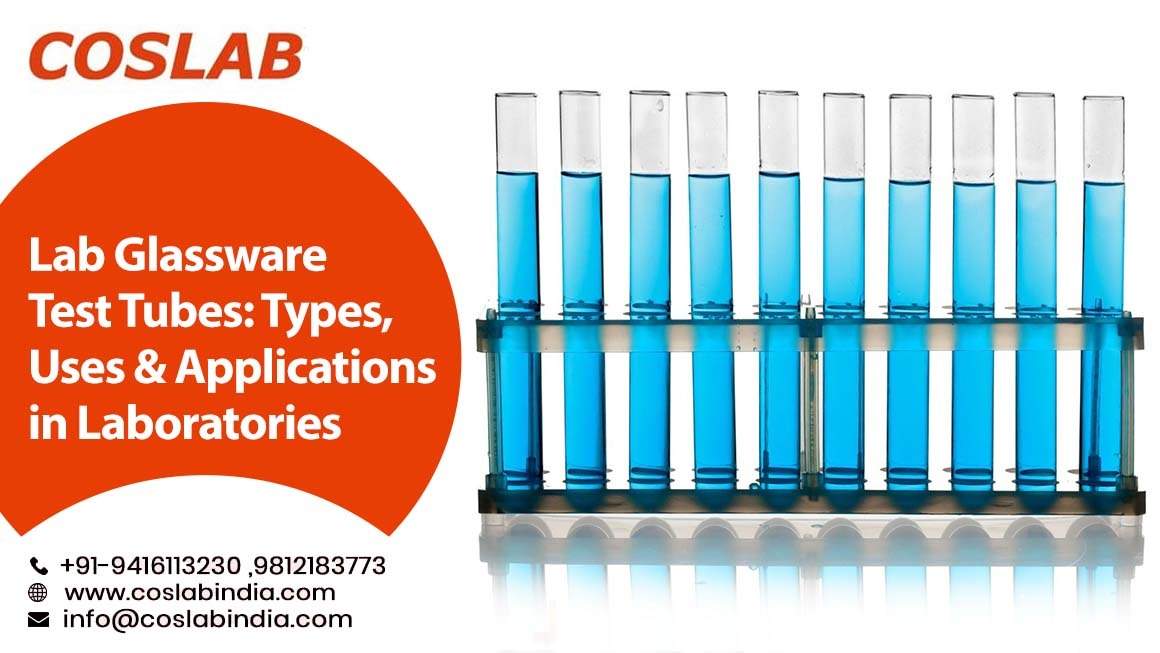
Lab Glassware Test Tubes: Types, Uses & Applications in Laboratories
Laboratories are constructed on accuracy and accuracy starts with the appropriate tools. One of the simplest and the most powerful tools present in scientific settings is Lab Glassware Test Tubes. They support the knowledge of countless discoveries each day, and they are silent in many cases, starting with controlled reactions through sample storage.
In this blog, we shall have a closer examination of the various types of test tubes, their materials, their special use in various industries, their safety, as well as how appropriate choice of quality can change everything in performance of a lab.
The fundamental aspect of Laboratory Accuracy
Test tubes are not merely pieces of glass that are cylindrical, but they are critical parts of laboratory workflow. Their existence affects efficiency, safety, and accuracy of the experiment.
Why are they indispensable?
- • They permit a limited mixing of chemicals in the small amounts.
- • They assist in safe heating in reaction of experiments.
- • They give them clear visibility to be observed and analysed.
- • They assist in keeping samples intact in research as well as education.
Even simple tests might be inaccurate and inconsistent without the use of dependable Lab Glassware Test Tubes.
How to use an appropriate test tube?
| Design variant | Best Suited For | Distinct Advantage |
| Standard Tube | Routine lab reactions | Everyday reliability |
| Boiling Tube | High-temperature work | Extra-thick walls |
| Culture Tube | Microbial studies | Sterilization-friendly |
| Graduated Tube | Approximate measurement | Marked precision |
| Centrifuge Tube | Sample separation | Structural balance |
This brief introduction shows the role of various designs in the scientific tasks.
Types of Test Tubes Rediscovered
Rather than classifying them conventionally, we are going to discuss them according to functional personality.
• The Everyday Performer
Laboratories are dependent on standard test tubes. They can easily perform mixing, small scale reactions and short term storage.
• The Heat Specialist
Boiling tubes are intended to get heated intensively. Their glass is thicker so that it is durable when exposed to flame or high temperatures.
• The Culture Companion
Culture tubes, which are used in microbiology, aid bacteria and other microorganisms to grow and be maintained at a constant level of sterility.
• The Measured Observer
Graduated tubes allow visual indicators of volume, so that during experiments it is easy to measure a liquid approximately and quickly.
Safety First: Best Techniques towards Longevity
Laboratories should implement appropriate care practices in order to deliver good performance.
Smart Handling Tips
- • Clamps/holders should be used during heating.
- • Empty tubes should not be exposed to flame.
- • Check cracks prior to use.
Cleaning & Maintenance
- • Immediately rinse following experiments.
- • Apply compatible cleaning agents.
- • Biological conditioning to sterilize.
Regular repair and maintenance imply good outcomes and prolongs the product life.
The selection of right fit in your laboratory
Before selecting the test tubes, consider:-
- • Nature of chemical exposure.
- • Max temperature requirements.
- • Volume capacity needed.
- • Frequency of sterilization.
- • Laboratory safety standards.
Informed decisions guarantee the uniformity in the results and efficiency of operations.
Conclusion
Scientific excellence is based on reliable laboratory equipment. Test tubes might seem to be mere trifles, but they are critical to experimentation, analysis, and innovation in industries. Their material strength, structural design and application versatility makes them essential in any laboratory organization.
When quality Lab Glassware Test Tubes is a priority in laboratories, it makes sure protection of accuracy, safety and the performance in the long term. Coslab India can also ensure that its customers who want to be certain and look for glassware solutions that are precision-oriented and, therefore, are reliable to be used in labs they cater to the same clientele.
FAQs
Q1. Do the test tubes match with chemicals?
Ans. The glass withstands majority of laboratory chemicals.
Q2. Is design variation related to performance?
Ans. Yes, there are certain laboratory requirements of each type.
Q3. Is it possible to direct flame heat in the test tubes?
Ans. Direct flame should only be applied on heat resistant types.
Q4. What are the differences between boiling tubes and the standard tubes?
Ans. Their walls are thicker and thus resistant to the higher heat.



Subscribe To Our Newsletter
Stay in touch with us to get latest news and discount coupons