

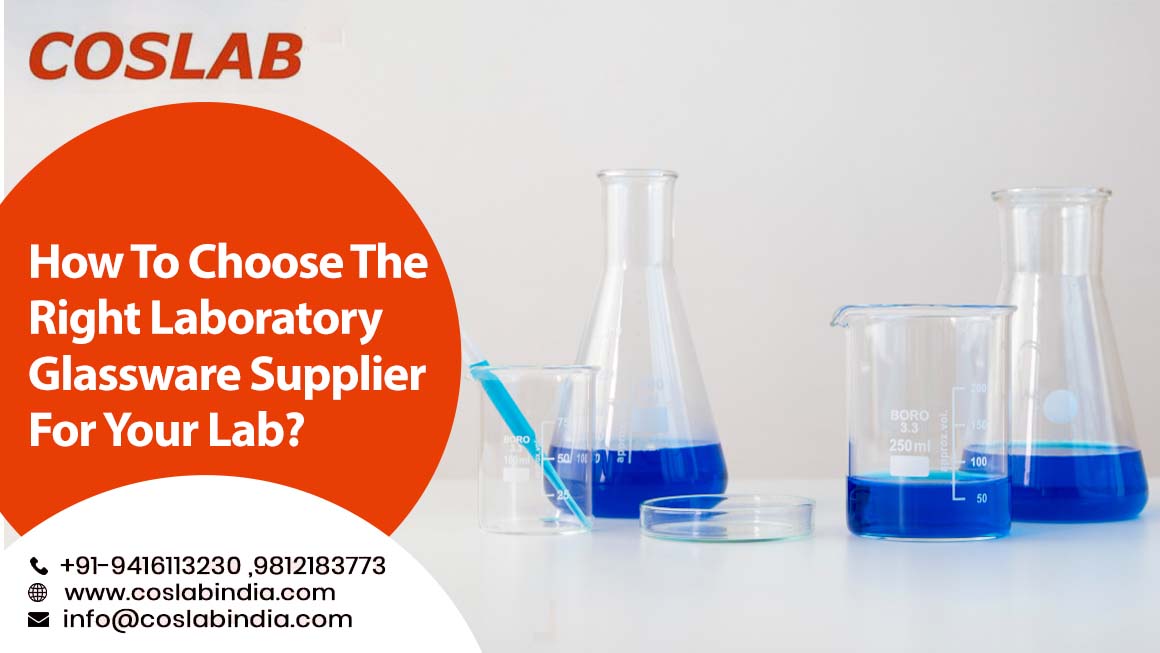
How To Choose The Right Laboratory Glassware Supplier For Your Lab?
Laboratory Glassware Supplier in India: Accuracy is the blood of any scientific activity. It is true that regardless of whether you are carrying out the high stakes pharmaceutical research, training the next generation of scientists in a university environment, or carrying out the ordinary quality control in a factory plant, the quality of the results that you will be able to achieve will heavily rely on the tools that you employ. Glassware is one of the long time staples. Locating a dependable Laboratory Glassware Supplier is an important measure towards safety, precision and durability in your operating room.
This blog will discuss why quality glassware is important to the scientific community and will also offer you a detailed roadmap to finding the partner that will fulfill your technical and the logistical requirements.
Learning about a Laboratory Glassware Supplier
One should know what a committed laboratory glassware supplier will actually bring to the table before committing themselves to the selection process. These are not just the suppliers who deliver crates of beakers and flasks to you, they are an intermediary between an art of specialized glass production and the art of the practical science.
A reliable supplier is aware of the distinction between soda-lime glass, which can be used in simple storage, and borosilicate glass, which is a necessity in the event of high thermal stress or hostile chemicals. With the appropriate supplier of laboratory glasses, you will finally be able to access products that meet international standards like ISO and therefore, your measurements will be accurate and your environment will not be at risk of shattering or leaching chemicals.
The most important considerations to make when selecting a supplier
The choice of a partner to your lab equipment is the process that can influence your budget and the quality of your research. The following are the main aspects to be considered:
1. Quality Requirement and Material Composition
The grade of glass supplied is the most critical. You must make sure that your supplier of laboratory glassware provides a high standard of borosilicate 3.3 glass.
• Thermal Resistance: Does the glass survive the fast change of the temperature?
• Chemical Stability: Does it react to water, neutral and acid solutions and strong alkaline mixtures?
• Certifications: Find suppliers that are ISO 9001 since they imply that they are committed to standardized quality management.
2. Diversity and Variety of Products
A lab's needs are diverse. You can require a mere graduated cylinder to complicated distillation equipment.
• Variety: Does the supplier have a one-stop-shop experience of beakers, pipettes, burettes, and test tubes?
• Specialization: Do they offer the specialized glassware?
• Stock Levels: An excellent laboratory glassware supplier has a vibrant inventory stock to avoid long lead times which may hold your projects.
3. Customization and Technical Support
In other cases, off-the-shelf products are not always suitable with a special experimental arrangement.
• Bespoke Designs: Determine whether the supplier is able to deal in custom glass blowing or customization.
• Professional Consultation: Does their staff provide you with advice on the type of glass to use with your particular chemical reactions?
The Impact of Pricing
Although cost is a mandatory factor, the lowest price is hardly the ultimate solution when it concerns lab safety. Poor glass can contain "stress points" or even uneven thickness of the wall, which will cause spontaneous breakage when either in vacuum or when heated. A competitive supplier of professional laboratory glassware offers a balance between the costs and the high-endurance, which will ultimately save you money by making the replacements less frequent and the laboratory accidents less common.
Conclusion
Although selecting a laboratory glassware supplier may seem to be only a matter of identifying a supplier, it is also a matter of finding a collaborator in your scientific endeavor. Coslab India has fulfilled this purpose over a period of more than 50 years, with a presence in 1972 giving it a chance to deliver ISO 9001:2015 and US-FDA certified instruments. By focusing on the quality of the material and a variety of inventory it will be possible to achieve maximal efficiency that is microscopes to glassware. This due diligence under a reliable supply of laboratory glassware would guard your data security and staff well being in the long run.
FAQs
Q1. Can all glassware be autoclaved?
Ans. Majority of borosilicate glassware can withstand autoclave. Nevertheless, it is always good to verify with your supplier of glassware in the lab on certain items, particularly those with plastic tops or additions.
Q2. Is it possible to recycle the old glassware?
Ans. Although the normal glass can be recycled, the lab glassware (particularly the borosilicate) does not melt at the same rate and should be disposed of following the relevant laboratory waste disposal guidelines.
Q3. What type of glassware does a pharmacy lab need?
Ans. Mortars and pestles, titration burettes, storage bottles and volumetric flasks are necessary.
Q4. Which are the indications of bad quality glassware?
Ans. Check the air bubbles, the stress lines, or irregularity of the thickness of the walls of the glass. Even in normal conditions, poorly annealed glass is likely to spontaneously break.



Subscribe To Our Newsletter
Stay in touch with us to get latest news and discount coupons