

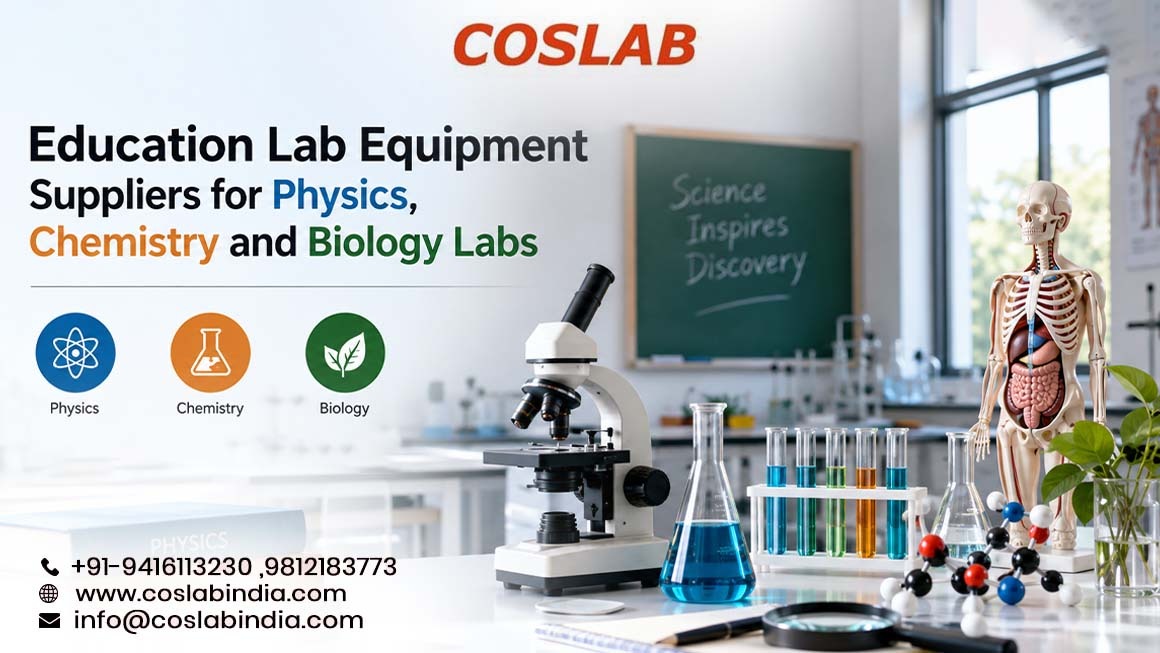
Education Lab Equipment Suppliers for Physics, Chemistry and Biology Labs
The key to good science teaching and learning is through experiential learning. Students who are beyond the pages of books and directly face the experimental apparatus, the complicated scientific theory turns into real. Whether it's for building a safe laboratory environment, purchasing top-of-the-line equipment, or creating a state-of-the-art lab, modern education institutions rely heavily on the quality of their education lab equipment suppliers.
The following blog gives a detailed description of the science laboratory apparatus used in different fields, the science laboratory instruments and its specifications, factors to be considered while procuring the science laboratory instruments and best practices for maintaining educational science laboratories.
Role of Education Lab Equipment Suppliers
It is important to know the reasons for choosing the right lab supplier before getting into the specifics of which configuration to use. Genuine lab equipment suppliers are not just vendors of apparatus; they are essential allies in the academic environment by offering apparatus that meets standards, is robust, and safe to use by students.
There are special requirements in an educational setting as opposed to an industrial laboratory. Student equipment must be robust enough to withstand regular use, be easy to operate, comply with rigorous safety standards and provide precise readings without complicated calibration procedures.
Key Laboratory Equipment for Core Science Disciplines
Specialized tools and equipment for the various core areas of science are necessary for a well-balanced science department. There are specific requirements for instrumentation that need to be used in each field to enable standard curriculum experiments to be conducted.
Physics Laboratory Essentials
Physics laboratories use apparatus to illustrate mechanics, electromagnetism, optics, thermodynamics and wave phenomena.
- Optical Instruments: Student compound microscopes, spectrometer setups, prisms, lenses and ray boxes to study refraction, reflection and light dispersion.
- Mechanics & Motion: Dynamics measures acceleration, gravity and momentum using track timers, ticker timers, pendulums, force tables and digital stopwatches.
Chemistry Laboratory Setup
Chemistry labs require a mix of glass, plastic and heating equipment that is designed to safely facilitate chemical reactions.
- Laboratory Glassware & Plasticware: Beakers, volumetric flasks, graduated cylinders, burettes, test tubes and volumetric pipettes of heat-resistant borosilicate glass.
- Heating & Thermal Equipment: Laboratory ovens, Incubators, bunsen burner, hot plate with the magnetic stirrer, water baths.
Biology & Life Sciences Equipment
Biology setups are based around cellular structure, examination of anatomical features and biological processes.
- Microscopes: Monocular, Binocular, Coaxial research and Digital head microscopes for the anatomical and cellular observations.
- Anatomical & Biological Models: 3D human anatomy models, plant cell structures, and botanical specimens.
Best Practices for Maintaining Educational Science Labs
While the purchase of good lab equipment is a first step, keeping good lab equipment means helping to ensure student safety and equipment longevity.
- Routine Calibration & Inspection: Regularly check and inspect electrical meters, weighing balances and optical alignments to ensure accurate readings.
- Proper Storage & Handling: Keep the optical devices such as microscopes in the dust free, dry cabinets so that mold will not grow on the lens. Store glassware in cushioned racks with a chemical resistant lining.
- Student Safety Protocols: Identify all equipment and provide proper eyewash stations, and have proper handling procedures for glassware, heating, and electrical circuits.
Summing Up
Providing schools with high precision, rugged tools that last for a long time creates a very motivating atmosphere for hands-on scientific exploration. Whether it's physics mechanics sets or chemistry volumetric glassware or biological microscopes, reliable education lab equipment suppliers are the corner stone of contemporary science teaching. When it comes to the reliable, high specification scientific and the educational instruments designed for modern laboratories, trust in Coslab India's experience and large options of products.
FAQs
Why is quality laboratory equipment essential for school science labs?
High quality equipment ensures safety, accurate experimental results and long lasting durability.
What basic equipment is needed for a high school physics lab?
Physics labs require optical devices, mechanics tracks, voltmeters, ammeters, prisms and thermodynamic instruments.
Why is borosilicate glass preferred over standard glass in labs?
Borosilicate glass resists thermal shock and chemical corrosion better than the standard glass formulations.
Are digital microscopes better for classroom instruction than traditional microscopes?
Digital microscopes allow instructors to project the images on screens for collaborative group viewing.
Education Lab Equipment Suppliers for Physics, Chemistry and Biology Labs
View More
Science Lab Equipment Manufacturer for High-Quality Laboratory Instruments
View More

How Does the Right Conical Flask Support Better Lab Results?
View More

How Culture Tubes Manufacturers in India Help Ensure Better Results
View More

Subscribe To Our Newsletter
Stay in touch with us to get latest news and discount coupons